Table of Contents
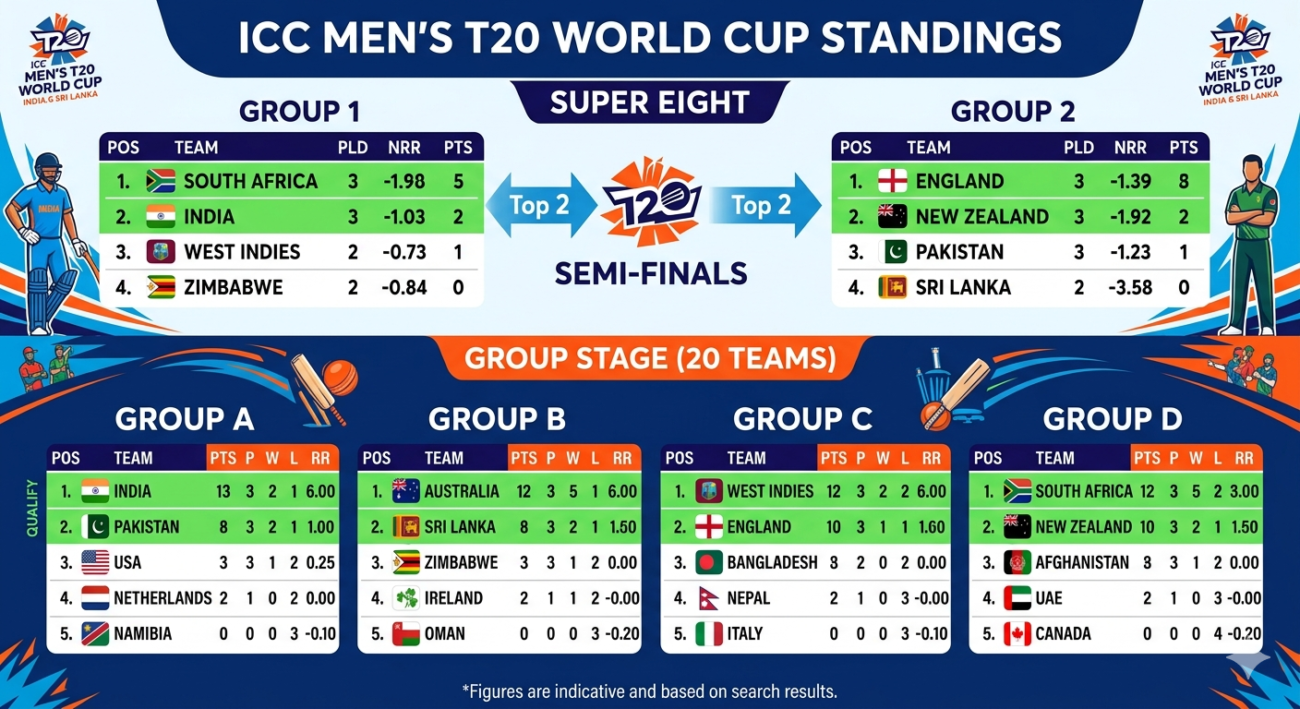
The T20 World Cup standings are one of the most closely followed aspects of international cricket tournaments. Fans eagerly track the points table to see which teams are leading their groups, who is likely to qualify for the next round, and which nations are struggling to stay in contention. The standings provide a quick overview of wins, losses, net run rate, and overall tournament performance. Whether you are a casual cricket fan or a dedicated follower, understanding how the standings work can make every match more exciting. This guide explains the T20 World Cup standings, qualification scenarios, ranking factors, and their impact on the tournament.
Understanding T20 World Cup Standings
The T20 World Cup standings are designed to show the performance of teams throughout the tournament. Every participating nation earns points based on match results, and these points determine their position in the table. Teams that consistently win matches move higher in the standings, while losses can significantly impact qualification chances.
The standings help fans and analysts compare teams fairly throughout the competition. Besides wins and losses, several other factors such as net run rate and tied matches can influence rankings. As the tournament progresses, the standings become increasingly important because every point can affect a team’s path to the knockout stages.
| Factor | Impact |
|---|---|
| Win | 2 Points |
| Loss | 0 Points |
| No Result | 1 Point Each |
| Net Run Rate | Tie-breaker |
How Points Are Awarded in the Tournament
The points system is straightforward but highly influential in determining team positions. A victory generally awards two points, while a defeat earns none. In matches affected by weather or other interruptions resulting in no result, teams usually share points.
This system encourages teams to focus on winning consistently rather than relying on a few standout performances. The simple structure also allows fans to quickly understand qualification scenarios. Teams accumulating points steadily are more likely to advance, while inconsistent performances can leave even strong teams vulnerable.
| Result | Points Earned |
|---|---|
| Win | 2 |
| Loss | 0 |
| No Result | 1 |
| Tie | Tournament Rules Apply |
Importance of Net Run Rate in T20 World Cup Standings
Net Run Rate (NRR) often becomes a decisive factor when teams finish with the same number of points. NRR measures how quickly a team scores runs compared to how quickly it allows opponents to score. A higher NRR can help teams secure qualification even when points are level.
Because of this, teams frequently aim for large victory margins. Captains and coaches often adjust strategies during matches to improve NRR, especially in the group stage. Fans regularly monitor NRR calculations because a single dominant performance can dramatically change the standings.
| Metric | Significance |
|---|---|
| Positive NRR | Strong Position |
| Negative NRR | Potential Risk |
| Equal Points | NRR Decides Rank |
| Large Wins | Improve NRR |
Group Stage and Its Impact on Rankings
The group stage forms the foundation of the T20 World Cup standings. Teams are divided into groups and compete against each other to accumulate points. Every match carries importance because the results directly affect rankings.
The group stage often produces surprises, with underdog teams challenging established cricket powers. Consistent performances across all group matches are essential because one unexpected defeat can affect qualification prospects. Teams must balance aggressive play with strategic planning to maintain favorable positions in the standings.
| Stage Element | Purpose |
|---|---|
| Group Matches | Earn Points |
| League Format | Fair Competition |
| Standings Updates | After Each Match |
| Qualification Spots | Top Teams Advance |
Qualification Through the T20 World Cup Standings
Qualification for the next stage depends largely on a team’s position in the standings. Typically, the top teams from each group advance to the Super Stage, Super Eight, or semifinals, depending on the tournament format.
This makes every match crucial. Teams near the top focus on maintaining momentum, while lower-ranked sides fight to keep qualification hopes alive. The standings provide a clear picture of which teams control their destiny and which rely on favorable results elsewhere.
| Qualification Factor | Importance |
|---|---|
| Total Points | Primary Criteria |
| Net Run Rate | Secondary Criteria |
| Head-to-Head | Sometimes Used |
| Group Position | Determines Advancement |
Historical Trends in T20 World Cup Standings
Over the years, several trends have emerged in T20 World Cup standings. Traditional cricket powers often dominate the rankings, but T20 cricket is known for unpredictability. Smaller cricket nations have occasionally disrupted standings with memorable victories.
These historical patterns highlight the competitive nature of the tournament. Teams that start strongly usually remain near the top, while slow starts can be difficult to overcome. Reviewing past standings helps fans understand how tournament momentum often shapes eventual champions.
| Trend | Observation |
|---|---|
| Strong Starts | Often Lead to Qualification |
| Upsets | Common in T20 Cricket |
| Consistency | Key to Success |
| Momentum | Influences Rankings |
Teams That Frequently Lead the Standings
Several cricketing nations have consistently performed well in T20 World Cups. Teams with strong batting depth, versatile bowling attacks, and experienced leadership often occupy top positions in the standings.
Leading teams usually combine skill with adaptability. They perform effectively in different conditions and against varied opponents. Their ability to secure crucial victories during pressure situations often separates them from the competition and keeps them near the top of the table.
| Team Quality | Benefit |
|---|---|
| Strong Batting | More Wins |
| Balanced Squad | Consistency |
| Experienced Players | Better Decisions |
| Adaptability | Improved Results |
Common Reasons Teams Move Up or Down the Standings
Changes in T20 World Cup standings can happen quickly. A convincing victory may push a team several places higher, while consecutive defeats can cause a significant drop. Injuries, weather interruptions, and poor form also influence standings.
The dynamic nature of T20 cricket means that standings remain fluid throughout the tournament. Fans often witness dramatic shifts in rankings within a few days, making the competition exciting until the final group matches.
| Reason | Effect |
|---|---|
| Big Victory | Move Up |
| Consecutive Losses | Move Down |
| Strong NRR | Ranking Advantage |
| Weather Impact | Shared Points |
Why Fans Closely Follow T20 World Cup Standings
The T20 World Cup standings provide a real-time picture of tournament progress. Fans use the table to track favorite teams, predict semifinalists, and understand qualification scenarios. The standings add excitement because every match result can alter the tournament landscape.
Media outlets, analysts, and cricket experts regularly discuss standings to evaluate team performance. For supporters, the points table creates anticipation and keeps interest high throughout the event. It transforms every game into an important chapter of the tournament story.
| Fan Interest | Reason |
|---|---|
| Qualification Race | High Drama |
| Team Comparison | Easy Analysis |
| Tournament Progress | Clear Overview |
| Match Importance | Increased Excitement |
Conclusion
The T20 World Cup standings are much more than a simple points table. They reflect team performance, determine qualification opportunities, and add excitement to every stage of the tournament. From points accumulation and net run rate calculations to group-stage battles and knockout qualification, the standings influence every aspect of the competition. Understanding how the T20 World Cup standings work helps fans appreciate the strategy and intensity behind each match. Keep following the latest standings throughout the tournament to stay informed about ranking changes, qualification scenarios, and the race to become T20 World Cup champions.
FAQs
1. What are T20 World Cup standings?
They are the official rankings of teams in the tournament based on points, wins, losses, and net run rate.
2. How many points does a team get for a win?
A team generally receives two points for winning a match.
3. What happens if teams have equal points?
Net Run Rate (NRR) is usually used to separate teams with the same number of points.
4. Why is Net Run Rate important?
NRR acts as a tie-breaker and can determine qualification when points are equal.
5. Do weather-affected matches impact standings?
Yes. Matches with no result often award one point to each team.
6. Can a team qualify without winning every match?
Yes. Teams can qualify through a combination of points earned and a favorable net run rate.