Table of Contents
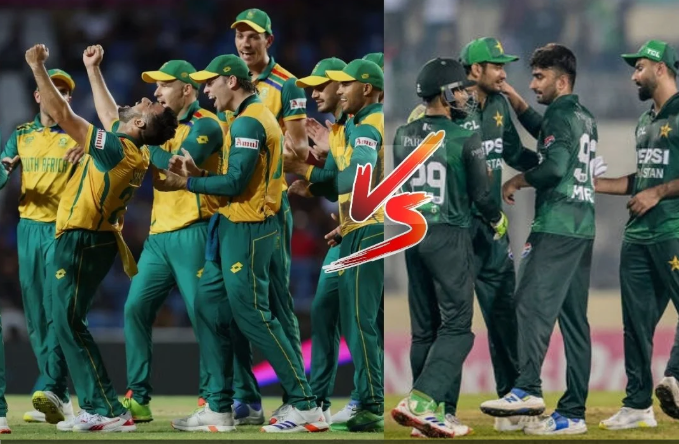
The rivalry between South Africa and Pakistan has produced plenty of close contests across Tests, ODIs, and T20Is. Their latest completed men’s ODI meeting came at Iqbal Stadium in Faisalabad on November 8, 2025, in the third match of South Africa’s tour of Pakistan. South Africa won the toss and elected to bat, but Pakistan’s bowlers quickly turned the match in their favor. South Africa were dismissed for 143 in 37.5 overs, with Abrar Ahmed taking four wickets and Shaheen Shah Afridi and Salman Ali Agha claiming two each. Pakistan then reached 144/3 in only 25.1 overs, led by Saim Ayub’s 77 from 70 balls. The result gave Pakistan a seven-wicket victory and a 2-1 series win.
Match Summary
| Match Detail | Information |
|---|---|
| Match | 3rd ODI |
| Date | November 8, 2025 |
| Venue | Iqbal Stadium, Faisalabad |
| Toss | South Africa won and batted first |
| South Africa | 143 all out |
| Pakistan | 144/3 in 25.1 overs |
| Result | Pakistan won by 7 wickets |
| Player of the Match | Abrar Ahmed |
| ODI Series Result | Pakistan won 2-1 |
Full Match Scorecard
First Innings Scorecard: South Africa
South Africa struggled to maintain momentum after a promising beginning. Quinton de Kock was the only batter to pass 50, while Pretorius provided useful early support. Once Pakistan’s spinners entered the attack, wickets arrived at regular intervals.
| Batter | Runs | Balls | Fours | Sixes |
|---|---|---|---|---|
| Lhuan-dre Pretorius | 39 | 45 | 4 | 1 |
| Quinton de Kock | 53 | 70 | 6 | 1 |
| Tony de Zorzi | 2 | 14 | 0 | 0 |
| Matthew Breetzke | 16 | 35 | 0 | 0 |
| Rubin Hermann | 1 | 2 | 0 | 0 |
| Donovan Ferreira | 7 | 11 | 1 | 0 |
| Corbin Bosch | 0 | 1 | 0 | 0 |
| Bjorn Fortuin | 3 | 5 | 0 | 0 |
| Nqabayomzi Peter | 16 | 31 | 2 | 0 |
| Nandre Burger | 3* | 12 | 0 | 0 |
| Lungi Ngidi | 0 | 1 | 0 | 0 |
| Extras | 3 | |||
| Total | 143 all out | 37.5 overs |
The innings shows why South Africa’s total was below par. De Kock’s 53 and Pretorius’ 39 accounted for 92 of the team’s 143 runs. The rest of the batting lineup contributed only 51 runs combined.
Bowling Figures: Pakistan
Pakistan’s bowling attack controlled the match through a combination of spin and disciplined pace bowling.
| Bowler | Overs | Runs | Wickets |
|---|---|---|---|
| Shaheen Shah Afridi | 4.5 | 18 | 2 |
| Saim Ayub | 7 | 30 | 0 |
| Haris Rauf | 3 | 17 | 0 |
| Salman Ali Agha | 4 | 18 | 2 |
| Abrar Ahmed | 10 | 27 | 4 |
| Mohammad Nawaz | 9 | 31 | 2 |
Abrar Ahmed was the standout bowler. His 4/27 came from the full 10-over spell, including one maiden, and his economy rate of 2.70 put sustained pressure on South Africa’s middle order. Shaheen, Salman and Nawaz provided strong support, giving Pakistan eight wickets among four different bowlers.
Second Innings Scorecard: Pakistan
Pakistan’s chase was much more controlled. Fakhar Zaman fell for a duck in the second over, but Saim Ayub and Babar Azam rebuilt the innings before Mohammad Rizwan guided the side home.
| Batter | Runs | Balls | Fours | Sixes |
|---|---|---|---|---|
| Fakhar Zaman | 0 | 2 | 0 | 0 |
| Saim Ayub | 77 | 70 | 11 | 1 |
| Babar Azam | 27 | 32 | 5 | 0 |
| Mohammad Rizwan | 32* | 45 | 3 | 1 |
| Salman Ali Agha | 5* | 2 | 1 | 0 |
| Extras | 3 | |||
| Total | 144/3 | 25.1 overs |
Saim Ayub’s strike rate of 110 was important because Pakistan did not simply defend the modest target. His 11 fours and one six kept the required rate comfortably under control. Rizwan then remained unbeaten until the finish.
South Africa Bowling Figures
| Bowler | Overs | Runs | Wickets |
|---|---|---|---|
| Nandre Burger | 5 | 29 | 1 |
| Lungi Ngidi | 3 | 17 | 0 |
| Corbin Bosch | 3 | 23 | 0 |
| Bjorn Fortuin | 6.1 | 34 | 1 |
| Donovan Ferreira | 4 | 21 | 0 |
| Nqabayomzi Peter | 4 | 18 | 0 |
Nandre Burger made the early breakthrough by removing Fakhar Zaman, while Bjorn Fortuin later dismissed Saim Ayub. However, South Africa could not build enough pressure around those wickets. Pakistan’s chase was completed with 149 balls remaining.
Fall of Wickets
South Africa
| Wicket | Score | Batter | Over |
|---|---|---|---|
| 1st | 72 | Lhuan-dre Pretorius | 14.2 |
| 2nd | 87 | Tony de Zorzi | 18.5 |
| 3rd | 106 | Quinton de Kock | 24.3 |
| 4th | 109 | Rubin Hermann | 25.1 |
| 5th | 117 | Donovan Ferreira | 27.3 |
| 6th | 117 | Corbin Bosch | 27.4 |
| 7th | 122 | Bjorn Fortuin | 28.6 |
| 8th | 130 | Matthew Breetzke | 33.2 |
| 9th | 143 | Nqabayomzi Peter | 37.4 |
| 10th | 143 | Lungi Ngidi | 37.5 |
The fall-of-wickets sequence shows the decisive phase clearly. South Africa moved from 106/3 to 117/6 in only a few overs, and the lower order could not recover.
Pakistan
| Wicket | Score | Batter | Over |
|---|---|---|---|
| 1st | 0 | Fakhar Zaman | 0.2 |
| 2nd | 65 | Babar Azam | 10.2 |
| 3rd | 130 | Saim Ayub | 23.4 |
Pakistan never lost consecutive wickets and maintained control after the early dismissal.
Match Result
Pakistan defeated South Africa by seven wickets after chasing 144 in 25.1 overs. The victory also secured the ODI series for Pakistan by a 2-1 margin.
South Africa had won the second ODI by eight wickets after Pakistan made 269/9, but Pakistan responded decisively in the decider. The three-match series therefore ended with Pakistan winning the first and third games, while South Africa took the second.
This was also significant for Pakistan because the victory gave them their first home ODI series win over South Africa. PCB reported that it was Shaheen Shah Afridi’s first assignment as ODI captain, making the series result particularly notable for the Pakistan side.
Player of the Match
Abrar Ahmed was named Player of the Match for his outstanding bowling performance.
His figures of 10-1-27-4 were the defining numbers of the game. Abrar removed Rubin Hermann, Donovan Ferreira and Corbin Bosch during a destructive middle-order spell, after already making the South African batting lineup uncomfortable.
His economy rate of 2.70 meant South Africa were unable to score freely against him. The four wickets also prevented the visitors from converting their strong opening partnership into a competitive total.
Key Moments
South Africa’s 72-run opening partnership
Pretorius and de Kock gave South Africa the start they needed. Their 72-run partnership accounted for half of South Africa’s eventual total and suggested that the visitors might establish a useful platform.
Salman Ali Agha breaks the opening stand
Salman dismissed Pretorius for 39 in the 15th over. He then removed Tony de Zorzi for only two, preventing South Africa from rebuilding after the first breakthrough.
De Kock’s dismissal changes the innings
De Kock was South Africa’s leading scorer, but Mohammad Nawaz removed him for 53 at 106/3. The wicket opened the door for Pakistan’s spinners to attack the inexperienced middle order.
Abrar Ahmed’s four-wicket burst
Abrar dismissed Hermann, Ferreira and Bosch in a devastating spell. Bosch fell for a golden duck, leaving South Africa at 117/6 and in serious trouble.
Saim Ayub controls the chase
After Fakhar Zaman fell for zero, Ayub took responsibility for the chase. His 77 from 70 balls contained 11 fours and one six and gave Pakistan enough momentum to keep the target comfortably within reach.
Rizwan closes the match
Mohammad Rizwan’s unbeaten 32 ensured Pakistan did not suffer a late collapse. Salman Ali Agha joined him at the end, and Pakistan reached 144/3 with plenty of overs remaining.
Match Highlights
- South Africa were bowled out for 143 in 37.5 overs.
- Quinton de Kock top-scored with 53.
- Lhuan-dre Pretorius made 39 from 45 balls.
- Abrar Ahmed claimed 4/27 from 10 overs.
- Shaheen Shah Afridi and Salman Ali Agha took two wickets each.
- Pakistan lost Fakhar Zaman for a second-ball duck.
- Saim Ayub scored 77 from 70 balls.
- Babar Azam contributed 27.
- Mohammad Rizwan remained unbeaten on 32.
- Pakistan reached 144/3 in 25.1 overs.
- Pakistan won by seven wickets with 149 balls remaining.
- Pakistan won the three-match ODI series 2-1.
Records and Statistical Highlights
One of the most striking features of the match was the contrast between the two innings. South Africa scored at only 3.78 runs per over, while Pakistan chased at 5.72.
Abrar’s 4/27 was the best bowling performance of the match. Pakistan’s six bowlers collectively kept South Africa below 150, while the visitors’ attack managed only two wickets through conventional bowling, with Babar Azam’s dismissal coming through a run-out.
Saim Ayub’s 77 was also comfortably the highest individual score in the Pakistan innings. His strike rate of 110 gave Pakistan a substantial advantage even though the target was relatively small.
| Statistical Category | Performance |
|---|---|
| Highest score | Saim Ayub, 77 |
| Highest South African score | Quinton de Kock, 53 |
| Best bowling | Abrar Ahmed, 4/27 |
| Second-best bowling returns | Shaheen Afridi, 2/18; Salman Agha, 2/18 |
| Best South African bowler | Nandre Burger, 1/29 |
| Fastest Pakistan scoring | Salman Agha, 5 off 2 |
| Highest partnership | 72, Pretorius/de Kock |
| Pakistan chase | 144/3 in 25.1 overs |
| South Africa innings | 143 all out in 37.5 overs |
Head-to-Head Record
South Africa have historically held the advantage in men’s ODIs against Pakistan. Through the end of the 2025 series, the teams had played 90 ODIs, with South Africa winning 53 and Pakistan winning 36, while one match produced no result.
That broader record provides useful context for the 2025 series. Pakistan’s 2-1 home-series victory did not erase South Africa’s long-term ODI advantage, but it added another important chapter to the rivalry.
The teams have also played substantial numbers of Tests and T20Is. Their Test rivalry has been particularly competitive over different eras, with South Africa holding the stronger overall record.
Recent Meetings
The teams met several times across formats during the 2024-25 and 2025-26 periods.
| Date | Format | Result |
|---|---|---|
| Dec. 22, 2024 | ODI | Pakistan won by 36 runs |
| Dec. 26, 2024 | Test | South Africa won by 2 wickets |
| Jan. 3, 2025 | Test | South Africa won by 10 wickets |
| Feb. 12, 2025 | ODI | Pakistan won by 6 wickets |
| Oct. 12, 2025 | Test | Pakistan won by 93 runs |
| Oct. 20, 2025 | Test | South Africa won by 8 wickets |
| Oct. 28, 2025 | T20I | South Africa won by 55 runs |
| Oct. 31, 2025 | T20I | Pakistan won by 9 wickets |
| Nov. 1, 2025 | T20I | Pakistan won by 4 wickets |
| Nov. 4, 2025 | ODI | Pakistan won by 2 wickets |
| Nov. 6, 2025 | ODI | South Africa won by 8 wickets |
| Nov. 8, 2025 | ODI | Pakistan won by 7 wickets |
The sequence demonstrates how closely contested the rivalry was during that period. Pakistan and South Africa exchanged wins across all three formats rather than one side dominating every series.
Why the Match Matters
The Faisalabad ODI was more than an isolated seven-wicket victory. It completed a comeback within the series after South Africa had won the second ODI.
Pakistan’s bowling performance was the foundation. Rather than relying entirely on one player, the attack produced wickets through Shaheen Afridi, Salman Agha, Mohammad Nawaz and Abrar Ahmed. That variety made it difficult for South Africa’s middle order to settle.
The chase then showed a different side of Pakistan’s performance. Ayub attacked when opportunities appeared, while Babar and Rizwan provided stability. Pakistan therefore combined aggressive scoring with controlled risk.
For South Africa, the match highlighted the cost of losing wickets in clusters. The opening partnership was promising, but once de Kock departed, the innings lost structure.
Tactical Analysis
The biggest tactical difference came in how the teams handled the middle overs.
South Africa’s opening pair managed to rotate the strike and find boundaries, but Pakistan changed the rhythm by introducing spin and attacking the middle order. Abrar’s spell was especially effective because South Africa could not afford to simply wait for bad balls.
Pakistan’s batting approach was more straightforward. After the early loss of Fakhar, Saim Ayub attacked the bowling while Babar Azam supported him. Their 65-run partnership stabilized the innings and pushed Pakistan toward a comfortable position. Rizwan then added another 65 with Ayub before Ayub’s dismissal.
The partnership numbers tell the story:
| Partnership | Runs |
|---|---|
| Fakhar Zaman & Saim Ayub | 0 |
| Saim Ayub & Babar Azam | 65 |
| Saim Ayub & Mohammad Rizwan | 65 |
| Mohammad Rizwan & Salman Ali Agha | 14 |
Two consecutive 65-run partnerships meant Pakistan recovered immediately after each setback.
Frequently Asked Questions
What was the final result between South Africa and Pakistan in the third ODI?
Pakistan defeated South Africa by seven wickets at Iqbal Stadium, Faisalabad, on November 8, 2025. South Africa scored 143 all out, and Pakistan reached 144/3 in 25.1 overs.
Who was the Player of the Match?
Abrar Ahmed was named Player of the Match after taking four wickets for 27 runs in 10 overs. His spell was central to South Africa’s collapse from 106/3 to 143 all out.
Who scored the most runs for Pakistan?
Saim Ayub was Pakistan’s leading run-scorer with 77 from 70 balls. He struck 11 fours and one six and finished with a strike rate of 110.
Who was South Africa’s top scorer?
Quinton de Kock scored 53 from 70 deliveries. He hit six fours and one six and was the only South African batter to reach a half-century in the match.
What was the series result?
Pakistan won the three-match ODI series 2-1. Pakistan won the first and third ODIs, while South Africa won the second match by eight wickets.
Conclusion
The Faisalabad decider was a clear example of how quickly an ODI can turn. South Africa had a strong start through Pretorius and de Kock, but Pakistan’s bowlers dominated the middle and lower order to restrict the visitors to 143. Abrar Ahmed’s four-wicket spell was the centerpiece of that effort. Pakistan then made the chase look comfortable, with Saim Ayub’s 77 providing the attacking momentum and Mohammad Rizwan finishing unbeaten. The seven-wicket victory secured a 2-1 ODI series win for Pakistan and added another significant result to a long-running international rivalry.
One thought on “South Africa National Cricket Team vs Pakistan National Cricket Team Match Scorecard”