Table of Contents
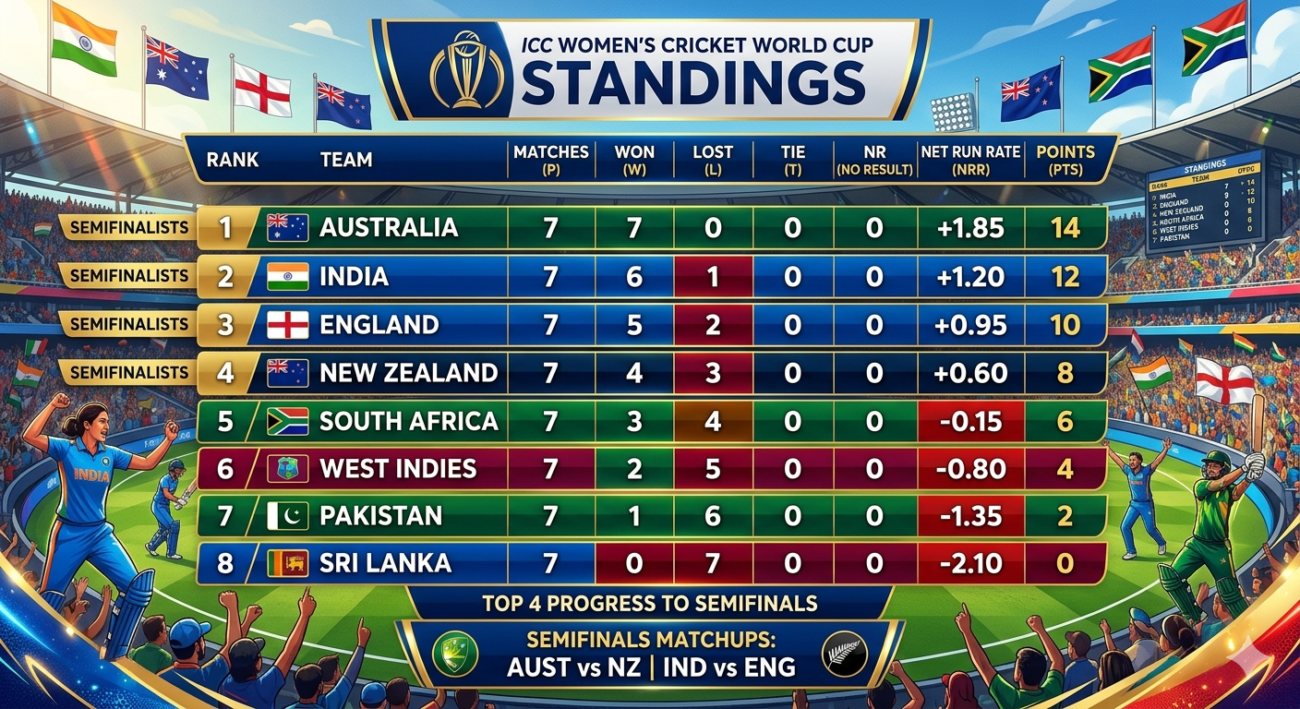
The Women’s Cricket World Cup standings are the heartbeat of the tournament, helping fans track which teams are leading the race for the title and which sides are fighting to stay alive in the competition. Every match impacts the points table, making the standings one of the most searched topics during the World Cup. Teams earn points through victories, while net run rate can play a decisive role when rankings are tight. Understanding the Women’s Cricket World Cup standings allows cricket enthusiasts to follow qualification battles, semifinal races, and title contenders. This guide covers everything you need to know about the standings, points system, rankings, and tournament implications.
What Are Women’s Cricket World Cup Standings?
The Women’s Cricket World Cup standings refer to the official tournament rankings that display how each team is performing throughout the competition. These standings are updated after every match and reflect points earned, matches won, losses suffered, and net run rate.
The standings provide a quick overview of which teams are in strong positions to qualify for the knockout stages. Fans rely on the points table to understand the current state of the tournament and predict which teams may advance. Since every match can change the rankings, the standings remain dynamic until the final group-stage fixture.
| Standing Metric | Purpose |
|---|---|
| Points | Determines Ranking |
| Matches Played | Tracks Progress |
| Wins | Measures Success |
| Net Run Rate | Breaks Ties |
How the Women’s Cricket World Cup Points Table Works
The points table is designed to reward consistent performance. Teams earn points for winning matches and compete to finish among the top-ranked sides in the standings.
A victory usually awards two points, while a defeat results in no points. Matches abandoned due to weather typically award one point to each team. This straightforward system ensures that teams focus on securing wins while also paying attention to their net run rate.
| Match Result | Points Awarded |
|---|---|
| Win | 2 |
| Loss | 0 |
| Tie | 1 |
| No Result | 1 |
Importance of Net Run Rate in Women’s Cricket World Cup Standings
Net Run Rate (NRR) often becomes the deciding factor when teams finish level on points. It measures how efficiently a team scores runs compared to how efficiently it allows opponents to score.
Teams often aim for dominant victories because a strong NRR can provide a crucial advantage. Even if two teams have identical points, the side with the superior NRR usually ranks higher in the standings. This makes every run and wicket important throughout the tournament.
| NRR Scenario | Impact |
|---|---|
| Positive NRR | Higher Ranking |
| Negative NRR | Lower Ranking |
| Equal Points | NRR Decides Position |
| Big Wins | Improve NRR |
Current Women’s Cricket World Cup Standings Structure
The standings typically feature several key columns that help fans understand team performance. These include matches played, wins, losses, points, and net run rate.
By reviewing these statistics, supporters can quickly identify which teams are dominating the competition and which sides need strong performances in upcoming matches. The standings provide a complete picture of the tournament at any given moment.
| Column | Meaning |
|---|---|
| P | Matches Played |
| W | Wins |
| L | Losses |
| PTS | Total Points |
Qualification Through Women’s Cricket World Cup Standings
One of the primary purposes of the standings is determining qualification for the knockout rounds. Teams positioned near the top of the table generally secure places in the semifinals or next tournament phase.
As the competition progresses, qualification scenarios become more complex. Teams may need specific results or favorable net run rates to advance. Therefore, standings are closely monitored by players, coaches, and fans alike.
| Qualification Factor | Significance |
|---|---|
| Points Total | Main Requirement |
| NRR | Tie-Breaker |
| Wins | Improves Position |
| Final Rank | Determines Advancement |
Teams That Usually Dominate the Standings
Historically, several women’s cricket teams have consistently occupied the top positions in World Cup standings. Their success comes from balanced squads, experienced players, and strong performances under pressure.
These teams often maintain high rankings throughout tournaments and are considered favorites for the title. Their ability to adapt to conditions and perform consistently helps them stay ahead of competitors.
| Team Quality | Advantage |
|---|---|
| Strong Batting | More Runs |
| Quality Bowling | More Wickets |
| Experience | Better Strategy |
| Squad Depth | Consistency |
Historical Women’s Cricket World Cup Standings Trends
Examining previous Women’s Cricket World Cup standings reveals important trends. Teams that begin tournaments strongly often remain near the top throughout the competition. Momentum can play a significant role in determining final rankings.
At the same time, the rise of competitive emerging teams has made the standings more unpredictable. Upsets and surprise victories regularly influence qualification races and add excitement to the tournament.
| Trend | Observation |
|---|---|
| Fast Starts | Often Lead to Qualification |
| Consistency | Key Success Factor |
| Upsets | Impact Rankings |
| Momentum | Drives Performance |
Factors That Affect Women’s Cricket World Cup Standings
Several factors can influence a team’s position in the standings. Winning matches remains the most important, but injuries, player form, weather conditions, and net run rate also play major roles.
A team can quickly move up the table with consecutive victories or fall behind after a series of losses. These fluctuations make the standings one of the most exciting aspects of the Women’s Cricket World Cup.
| Factor | Effect on Ranking |
|---|---|
| Consecutive Wins | Move Up |
| Consecutive Losses | Move Down |
| Strong NRR | Ranking Boost |
| Weather Interruptions | Shared Points |
Why Fans Follow Women’s Cricket World Cup Standings
Fans closely follow the Women’s Cricket World Cup standings because they provide insight into the tournament’s biggest storylines. The standings help supporters understand which teams are likely to qualify and which are under pressure.
Whether tracking a favorite team or analyzing championship contenders, the standings make every match more meaningful. They add excitement, context, and anticipation throughout the tournament.
| Fan Interest | Benefit |
|---|---|
| Qualification Race | More Excitement |
| Team Tracking | Easy Comparison |
| Rankings Analysis | Better Understanding |
| Tournament Progress | Clear Overview |
Conclusion
The Women’s Cricket World Cup standings are essential for understanding the progress and competitiveness of the tournament. They reveal which teams are performing consistently, who is likely to qualify for the knockout rounds, and how net run rate can influence rankings. From the points table structure to qualification scenarios, every aspect of the standings plays a crucial role in shaping the World Cup journey. As the tournament unfolds, following the Women’s Cricket World Cup standings helps fans stay informed, engaged, and connected to the race for cricket’s most prestigious women’s title.
FAQs
1. What are Women’s Cricket World Cup standings?
Women’s Cricket World Cup standings are the official rankings that show how teams are performing in the tournament based on points, wins, losses, and net run rate.
2. How are Women’s Cricket World Cup standings calculated?
The standings are calculated using points earned from match results. Teams receive points for wins, while net run rate is used as a tie-breaker when teams have the same number of points.
3. What is Net Run Rate (NRR) in Women’s Cricket World Cup standings?
Net Run Rate is a statistical measure that compares a team’s scoring rate with the scoring rate of its opponents. It helps determine rankings when teams are tied on points.
4. How many points does a team receive for winning a match?
A team usually earns two points for a victory in the Women’s Cricket World Cup.
5. Can a team qualify for the semifinals with the same points as another team?
Yes. If teams have equal points, net run rate is generally used to decide which team ranks higher and qualifies.
6. Why are Women’s Cricket World Cup standings important?
The standings determine team rankings, qualification for knockout rounds, and help fans track the progress of the tournament.
7. How often are Women’s Cricket World Cup standings updated?
The standings are updated after every completed match, ensuring that fans always have the latest tournament rankings.